
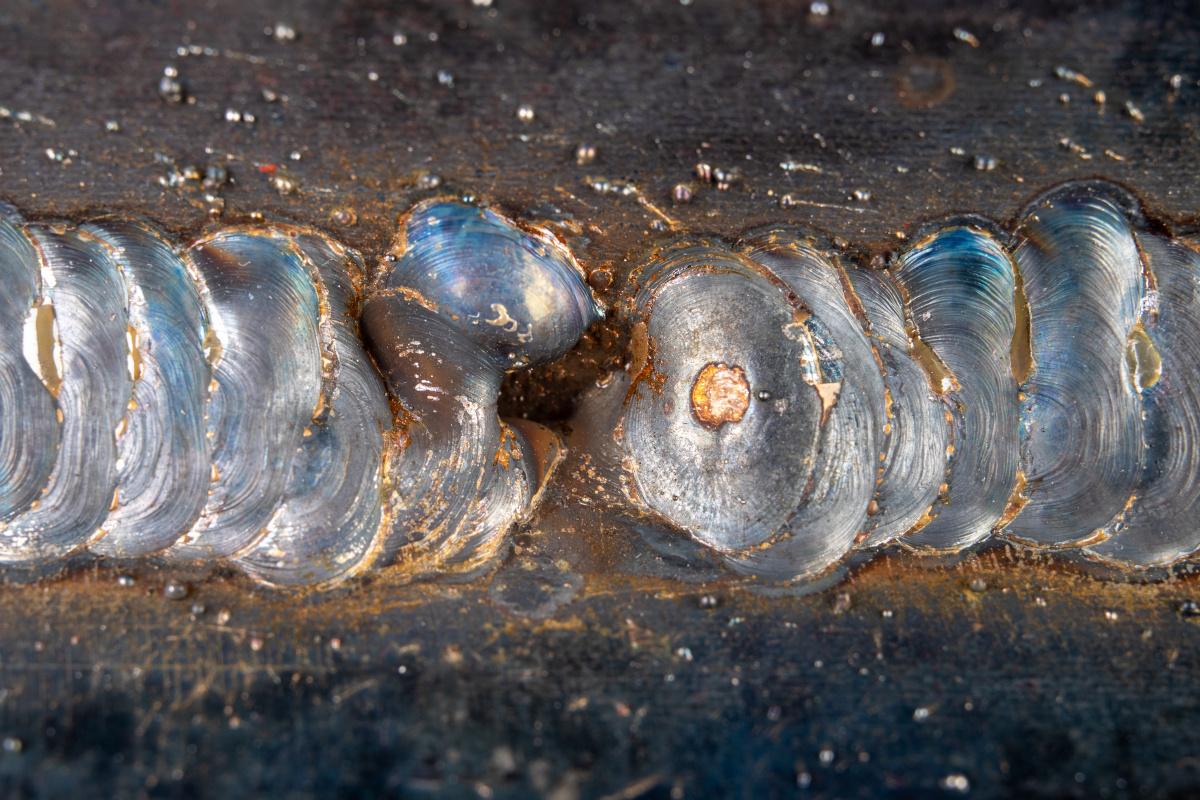
Welding defects are among the greatest challenges in the field of joining. They have a direct impact on the quality, strength, and service life of a welded joint, regardless of which metals or special materials you are processing. Even small deviations during welding can lead to typical weld seam defects such as porosity, cracks, or slag inclusions. Identifying these defects early on and consistently avoiding welding defects protects the components and greatly increases process reliability. Schnelldorfer Maschinenbau shows you how to do this.
What are welding defects and why are they so bad?
Welding defects are irregularities in a weld seam that can impair the stability, tightness, or durability of a joint. These include both visible weld seam defects on the surface and internal defects hidden deep within the material. Standards such as ISO 5817 or AWS D1.1 specify which defects are still permissible and to what extent, and at what point safety can no longer be guaranteed.
In industrial manufacturing in particular, a single error can have far-reaching consequences. These range from scrap and component failure to prolonged production downtime. That is why it is so important to systematically avoid welding errors and consistently ensure the quality of weld seams.
External welding defects: Visible warning signs
External welding defects are visible directly on the weld surface and are among the most common causes of quality problems. Typical examples include porosity, visible cracks, overlap, spatter, or undercut burn marks. They are often caused by contaminated component surfaces, unfavorable torch positioning, excessive or insufficient welding speed, or simply by incorrectly set welding parameters.
The advantage: many of these defects can be detected by a simple visual inspection. In addition, testing methods such as magnetic particle or dye penetration testing help to reliably detect even fine surface defects. If action is taken early, consequential damage and unnecessary rework can be significantly reduced, and the quality of the weld seam is noticeably improved.
External welding defects at a glance
- porosity
- Visible cracks and crater cracks
- overlap
- Undercut burn-in notches
- splash
- seam elevation
- Uneven weld beads
- Rough or irregular seam surface
Internal welding defects: The invisible danger
Internal defects are particularly critical because they cannot be detected with the naked eye. These include slag inclusions, incomplete penetration, insufficient fusion, or trapped gas bubbles. They are often caused by insufficient heat input, incorrect welding speed, or poorly prepared joints.
Since internal welding defects affect penetration and weld depth, they can, in the worst case, lead to spontaneous component failure. Non-destructive testing (NDT) methods such as ultrasonic, X-ray, or eddy current testing are therefore used to detect them. These methods reveal even fine structural deviations and thus make a significant contribution to quality assurance.
Internal welding defects at a glance
- slag inclusions
- Incomplete penetration
- Lack of fusion or incorrect root position
- Trapped gas bubbles or gas porosity
- Bonding defect between weld metal and base material
- Internal cracks and cold cracks
- Local areas with insufficient weld depth
Causes of welding defects – Where problems really arise
Welding defects rarely have a single cause. Often, several factors interact, ranging from the condition of the material to the settings on the welding machine to the environment. Contaminants such as oil, rust, moisture, or paint residues are among the most common triggers: they interfere with the weld pool, lead to porosity and trapped gas bubbles, and thus affect the bond between the weld metal and the base material.
Incorrect parameter settings also contribute significantly to typical weld seam defects. For example, an unsuitable electrode angle, an excessively long arc length, or an unstable gas flow can promote both cracks and incomplete penetration. Even environmental conditions play a role: drafts cool the weld pool too quickly, while low temperatures make it difficult to apply heat and an uneven surface makes it difficult to guide the torch evenly.
If you want to avoid welding defects, you should always consider the overall picture, because everything must fit together to create a stable and flawless connection.
Common welding defects, their causes, and solutions
| error | cause | solution |
| porosity | Contamination, incorrect protective glass | Cleaning, optimizing gas flow |
| cracks | Excessive heat input, stresses | Preheat, adjust welding sequence |
| Undercut (burn marks) | Excessive current, incorrect angle | Reduce parameters, improve burner maintenance |
| slag inclusions | Incorrect electrode angle, poor cleaning | Keep joints clean, clean weld layers |
| Incomplete penetration | Insufficient heat, incorrect geometry | Increase current, adjust gap and angle |
Welding technology and welding parameters – The foundation for flawless weld seams
Whether a weld seam is clean, stable, and free of welding defects is determined by the selection and setting of the correct welding parameters. Current, voltage, polarity, and welding speed directly influence the welding process and thus everything related to penetration, seam height, and the shape of the weld bead. If these values are not correctly adjusted to the material used or the sheet thickness, the risk of defects increases. Risk of undercutting, overlapping, or uneven seam structures rapidly.
Correct welding technology is equally important, and the preparation of the weld seam should not be underestimated: a suitable gap, clean edges, the correct root opening, and the removal of slag or coatings create the best basis for a secure fusion. This prevents weld seam defects even before the arc is ignited.
Avoiding welding defects – 10 practical measures
You can permanently improve the quality of the welded joint by taking the following measures:
- Clean the workpiece thoroughly—completely remove rust, oil, paint, and moisture.
- Select the appropriate filler material—adapt the material, diameter, and properties to the application.
- Adjust and document welding parameters – ideal for reproducible results.
- Check the shielding gas supply – ensure gas flow, nozzle distance, and purity.
- Stable torch positioning – maintain a constant arc length and smooth guidance.
- Preheat if necessary—especially for high-strength steels to prevent cold cracks.
- Optimized seam preparation—ideal gap, correct edge shape, clean surfaces.
- Plan the weld seam sequence to minimize internal stresses and distortion.
- Fix components in place – ensure stable stitching and secure positioning.
- Maintain and calibrate welding equipment – ensure reliable performance and consistent parameters.
Minimize welding defects by choosing the right materials and preparing carefully
The choice of the right material and filler material has a decisive influence on how well a component can be welded and what properties the joint will have later on. Compatible filler metals that match the material grade reduce material stresses, for example, and thus support reliable fusion between the base material and filler material. The condition of the filler material is also important: dry electrodes and cleanly stored wires prevent moisture ingress—the most common cause of porosity or gas bubbles.
Preparing the workpiece is equally important. Grinding, degreasing, or removing old coatings allows the weld pool to flow smoothly and stably. The better the surface is prepared, the lower the risk of weld seam defects—especially with alloys that are sensitive to contamination. With good preparation, you can rule out welding defects right from the start.
Specifically avoid welding distortion, cracks, and penetration defects
Welding distortion, cracks, and penetration defects are primarily caused by uncontrolled heat input and the resulting stresses in the material. The reason: the material shrinks during cooling, which promotes deformation and can cause hot cracks or cold cracks if heat control is inadequate. These risks can only be significantly reduced through precisely controlled heat input, controlled cooling, and stable tack welds.
Practical techniques such as backstepping, counter-welding, or symmetrical seam placement also support even stress distribution and further improve the stability of the construction. Carefully control the arc energy to prevent burn-through or incomplete penetration, especially when TIG welding or joining thin-walled metal parts. This results in a weld seam that is visually appealing and structurally sound.
Non-destructive testing – early detection of welding defects
Non-destructive testing (NDT) methods are now an integral part of modern quality assurance. And for good reason, because methods such as ultrasonic, X-ray, magnetic particle, or dye penetrant testing are used to reveal both internal and external welding defects—without damaging the component. This pays off especially in safety-critical areas such as pressure vessel construction, plant engineering, or aerospace and automotive engineering. But you can also use the testing method to detect sources of error at an early stage in other areas. This allows you to take immediate countermeasures to prevent major damage.
Avoid welding errors with automated solutions from Schnelldorfer Maschinenbau
The automated welding systems from Schnelldorfer Maschinenbau eliminate many typical sources of error right from the start of the process. This is due, among other things, to the powerful combination of precise torch guidance, constantly monitored welding parameters, and the intelligent control system. This allows you to combat all welding errors, from crater cracks to overlaps, without any additional effort. Especially in series production and demanding industrial welding constructions, the welding systems score points with process reliability that pays off.
Would you like to optimize your production and guarantee the avoidance of welding errors? Schnelldorfer Maschinenbau supports you with modern welding technology, individually configurable systems, and decades of experience. Contact us now—we look forward to your welding project!
Frequently asked questions (FAQ)
What are the most common welding defects?
Typical welding defects include porosity, cracks, undercut, overlap, slag inclusions, and penetration defects. These are usually caused by unsuitable parameters, contaminated surfaces, or uneven heat input.
How can internal weld defects be detected?
Internal welding defects can be detected using non-destructive testing methods such as ultrasonic, X-ray, eddy current, or magnetic particle testing. These methods allow for accurate assessment of the weld depth and internal structure.
Which welding parameters have the greatest influence on seam quality?
Current, voltage, welding speed, and arc length have the greatest influence on seam quality. If they are not adjusted to the material and seams, the risk of errors increases significantly.
How can you avoid distortion during welding?
Distortion can be reduced by controlled heat input, a well-planned weld sequence, stable tack welds, and suitable clamping technology. Symmetrical welding strategies and regular cooling phases are particularly helpful in this regard.
 German
  English
